The digital strategy at Kirby Engineering Group is all about increasing efficiencies, reducing silos and making life easier, and Autodesk software and systems are playing a vital role in helping to achieve this. Read the full article in the Irish Building Magazine on pages 69-73.
Kirby Engineering Group, has form when it comes to recognising and embracing the benefits of technology. The 61-year-old mechanical and electrical engineering contractor, which employs 1,900 people across Ireland, UK, mainland Europe and South Africa was an early adopter of BIM in 2012, when the construction industry in Ireland was still in the doldrums. BIM was a requirement on a project the company was bidding for, and the director of innovation believed it would become increasingly important across the industry.
The bid was successful and Mark Danaher, now director – digital construction and IT, joined the company around this time to work on the project and to look at BIM’s potential going forward.
The company has also been quick on the uptake when it comes to off-site manufacturing (OSM). “We were doing a lot of big projects – hyperscale data centres and large pharmaceutical plants,” Danaher says.
“The bigger the project, the more people were on site and the more complex it was. We thought that if we could build modules in a safer, more controlled environment, we could reduce the amount of site storage and the number of people on site.”
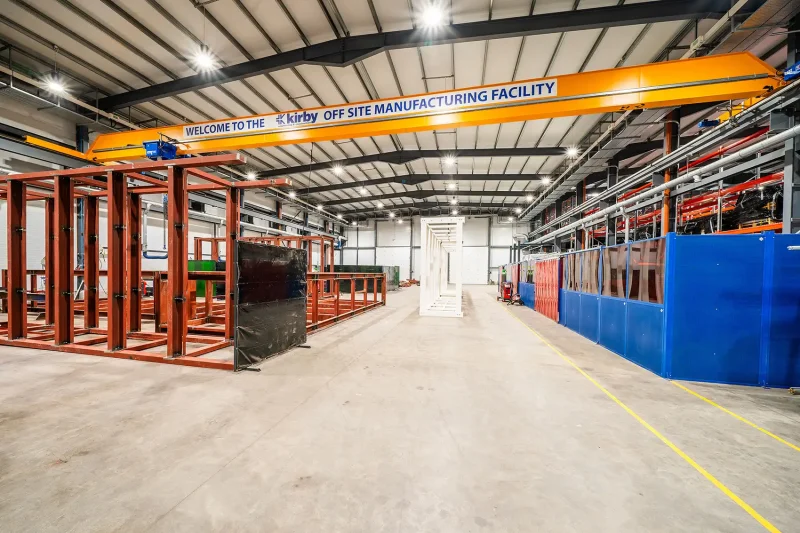
The company started its OSM journey about three years ago, initially making all brackets at a small workshop in Athlone. “Then we thought we could build 12m x 4m modules with multiple systems – piping, electrics and equipment – that we could ship to site. We realised that instead of having 20 people on site working at height, we could have them working on the equipment on the ground.”
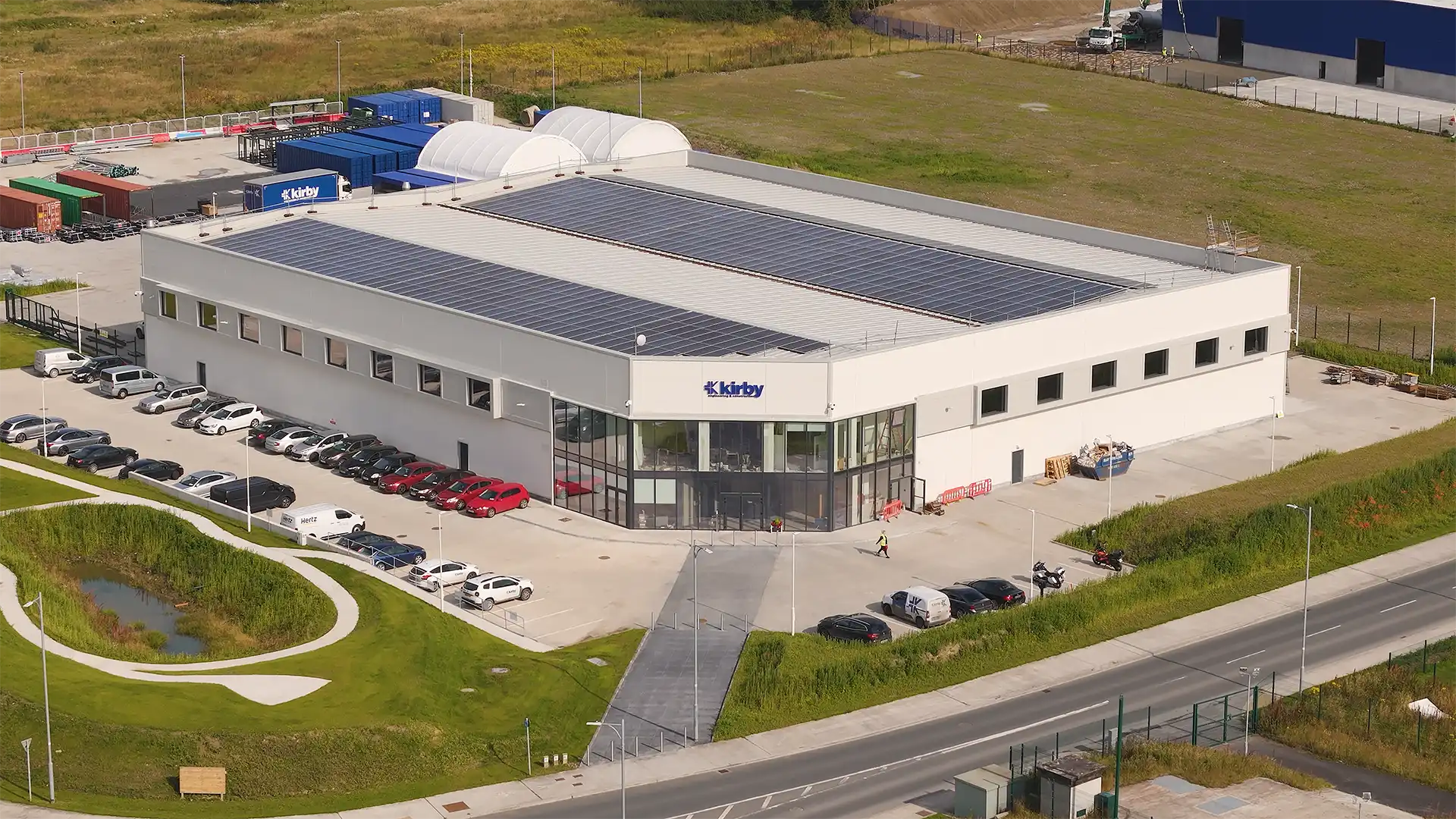
After a year in Athlone, the company made the decision to invest €8m to establish a dedicated off-site manufacturing factory in Portlaoise to make components to be shipped to sites in Ireland, the UK and Europe. Opened in November 2024, the facility initially employed 20 people. As demand has increased from the company’s projects across Europe, the facility’s size and employee numbers have since doubled.

Danaher says OSM is providing incredible savings in terms of hours spent on site, the amount of equipment kept on site, scheduling control, quality control and, of course, health and safety. The target is for 25% of all projects to be completed through prefabricated methods and the facility is central to that.
The OSM team in Portlaoise provides manufacturing, engineering and digital construction services. Items manufactured at the facility include e-houses electrical rooms, package plantrooms, electrical modules, mechanical modules, MEP modules, external pipe/ containment racks, pump skids, riser modules and bespoke services. The development has a dedicated cleanroom to allow for high purity pipework, as required by many of Kirby’s high-tech clients.
Many customers recognise the benefits of prefabrication and demand for this method is growing. “Some of our clients are designing their new facilities with a modular approach in mind,” Danaher says. “They’re saying, for example, that they want 80% of it manufactured offsite. Others don’t think too deeply about the modular side of things and that’s where we bring our own quality to it. We can co-ordinate their building in a way that we modularise as much as possible for our own benefit and also for theirs.”
Autodesk software and systems play a big role in the process. “We have a digital construction team working on each of our projects and utilising different software to essentially recoordinate the systems to allow us build using a modular approach. We build a 3D model of the project, and we use Revit, Plant 3DandNavisworks.”
Autodesk Construction Cloud (ACC), a cloud-based platform, links everything – software, data and workflows – together.
“Once the 3D models are done and the drawings are ready, they automatically sync through ACC back to the manufacturing facility, where the information is imported into Fusion Ops,” Danaher says.
Autodesk’s Fusion Operations is a manufacturing execution system (MES) that provides real-time data for production management. It plans production schedules, tracks inventory and manages product quality.
“It’ll see, for example, that you’ve coordinated a piping system, breaks down all the material needed from the 3D model and automatically generates a parts list. The manufacturing facility manager knows what’s required to build the component and what parts need to be ordered. It automatically does call cut links as well and gives all that information down onto the shop floor.”
Everyone on the floor has access to a digital screen and Fusion Ops informs them of the jobs they have for the day, the amount of pipe they need to cut and the cutting dimensions. “They accept the job and start doing their cutting, their welding and fixing. As they do that, they have quality checklists built into Fusion Ops so they’re marking off that it’s been done the correct way and linking it all back. Fusion Ops manages the workflow right from the project design, which could be in Sweden, back to our facility in Portlaoise, through each of the different phases of manufacturing until it goes out on the truck and to the project in Sweden. We have five or six software packages that are pulled together and work in tandem through Autodesk.”
The new system’s users see the benefits, Danaher says. “Our manufacturing team had not used Fusion Ops before. Autodesk sent a Fusion Ops team who worked with us over two weeks to embed the software. We have a dedicated admin of the software who is constantly training the team. Once they get used to it it’s an easier way of working for them.”
It’s early days and the company is still analysing the data around the impact of the new system. “But we can see that the guys are already saving time when it comes to tracking down information or resources – it’s a much smother process. We use a cellular layout, so each team has its own area, and they all have access to the live information. That saves the equivalent of several hours a day.”
On the costs side, the facility has a leaner warehouse. “You can order materials as you need them. We’re not over-purchasing.”
Quality has also improved. “They have all the information and the material to hand. The quality checks are being carried out after each area. The level of accountability and transparency is second-to-none.”
Sustainability Matters
The company is currently finalising its sustainability roadmap for the next five to ten years; two of the key pillars in the strategy are people and planet, both of which are directly impacted by the OSM.
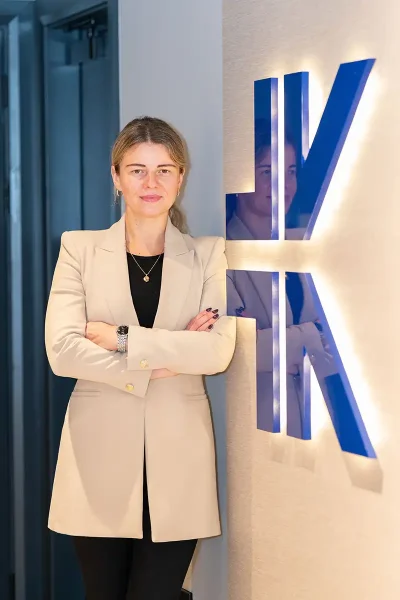
On the planet side of things, EHS and sustainability director, Giedre Visockaite, notes that the Portlaoise site was specifically chosen for its central location, reducing transport costs.
“There’s also a circularity piece: centralised production improves materials control, reducing waste and enabling reuse,” she says.
Solar PV panels have been installed to provide renewable electricity to the facility, thus reducing its carbon footprint. The original building has 200Kw of solar PV and a further 200Kw is to be installed on the extension. Visockaite says on average, solar PV meets 35% of the plant’s electricity demand, with a peak of 65% in July 2025.
There’s a strong people element too, the most important of which is improved health and safety.
“Being in a controlled environment, there are reduced hazards. Manufacturing in a factory environment allows us to complete the works in a safer, cleaner environment, with reduced exposure to weather, site hazards and taking much of the labour-intensive manual work from the construction site. The environment is cleaner and there’s less dust and emissions.”
There’s also more scope for improving skills and development. In addition to the fabrication element, the Portlaoise building has office space and a dedicated apprenticeship training centre. “This allows for classroom-based and practical education,” Visockaite says. “The full training takes about four days.”
Bound by ACC
Linking everything together is ACC, which is being rolled out across all projects. Kirby introduced BIM 360 – the precursor to ACC – in 2016. “We trialled ACC from 2022 on three hyperscale datacentre projects and in January of this year, the Kirby board mandated that it be used across the entire company on all projects.”
Danaher and his team are also developing Kirby Kore, a centralised digital hub for information. “Our strategy was to digitise as many of our projects and support functions as possible,” he says.
“We assessed all our processes and functions and examined how to apply technology to them to make them leaner and to digitise them with the ultimate goal of getting all the information into Kirby Kore.”
“We’ve essentially created a data lake. We want senior management in the business to have access to information in real time about projects, functions, quality, the EHS – where we are at any given time.”
The first system connected to Kirby Kore was ACC. All information captured on that platform – quality checklists, drawings, issues, etc – is now filtering back into this centralised area. “We can connect that with our other systems: we have our ERP system, ACC, Lessons Learned application, EHS and our HR handbook connected. That gives us real insights in real time through the power of AI. We want one unified area where all our information and the system it comes from are stored and can report out using very concise live data. That’s the digital plan for Kirby.”
AI has been a parallel project and Kirby is taking a two-pronged approach, launching Microsoft’s Copilot and the Autodesk AI, which is built into ACC. Copilot will read all of Kirby’s documentation, summarise and help navigate day-to-day work within the Microsoft environment.
Then there’s a custom-built AI bot, KAI, which will be linked to ACC, Lessons Learned, Kore and the HR handbook. “You can type in ‘tell me everything I need to know about all of my issues on all of my projects with regards to ACC’. KAI will log into ACC and all the other system for you, see all the projects you’re on and tell you the issues associated with you and your projects. You can ask what actions you need to complete and it will refine it down and point you to what you need to do. It means you don’t have to log into ten different applications and figure out where you are. It’s your own personal assistant, bringing everything together, summarising and helping.”
The ongoing digital transformation at Kirby is about bringing everyone together with centralised information and making life easier. “There are no silos,” Danaher says. “These are digital tools to help people to work more efficiently. Not replace what they do.”

Strong connections
Kirby has been using Autodesk products since 2006 and has built up a strong two-way relationship with the global software company. For example, when BIM 360 was being launched Kirby got access to the development team in the US. “We met them every month and gave feedback on BIM 360 and where we saw the need with regards to construction workflows in ACC.”
The company was part of the construction team that built Autodesk’s EMEA headquarters in Dublin, which opened in 2018. “We meet them regularly now in Dublin and work with them closely on any feedback around gaps we see in the software. Autodesk has taken our feedback on board and added developments to the product.
“The customer support team and more senior people are really quick to help us with any problem we have. They see Kirby as a partner and we see them as a partner, rather than it just being a ‘supplier-customer’ relationship.”
The journey with Autodesk and with AI looks set to continue. Kirby is trialling a beta-version of the next iteration of ACC, which will include neural CAD, which Autodesk says could automate a substantial proportion of routine design tasks. “We have the beta and we’re testing AI within ACC and it’s working very well. It’s early days – but it’s a really exciting experience.”